
AI for Engineering Knowledge Management
4 cloud CAD assistants tested: Which AI copilot integrates with your PLM workflow? Compare features, pricing and iteration speed.
·
⏱
9 min read

Dr. Maor Farid
Maor Farid is the Co-Founder and CEO of Leo AI, the first AI platform purpose-built for mechanical engineers. He holds a PhD in Mechanical Engineering and completed postdoctoral research at MIT as a Fulbright fellow. A Forbes 30 Under 30 honoree and former AI researcher and Mechanical Engineer in an elite military intelligence, Maor leads Leo AI's mission to transform how engineering teams design better products faster.

BOTTOM LINE
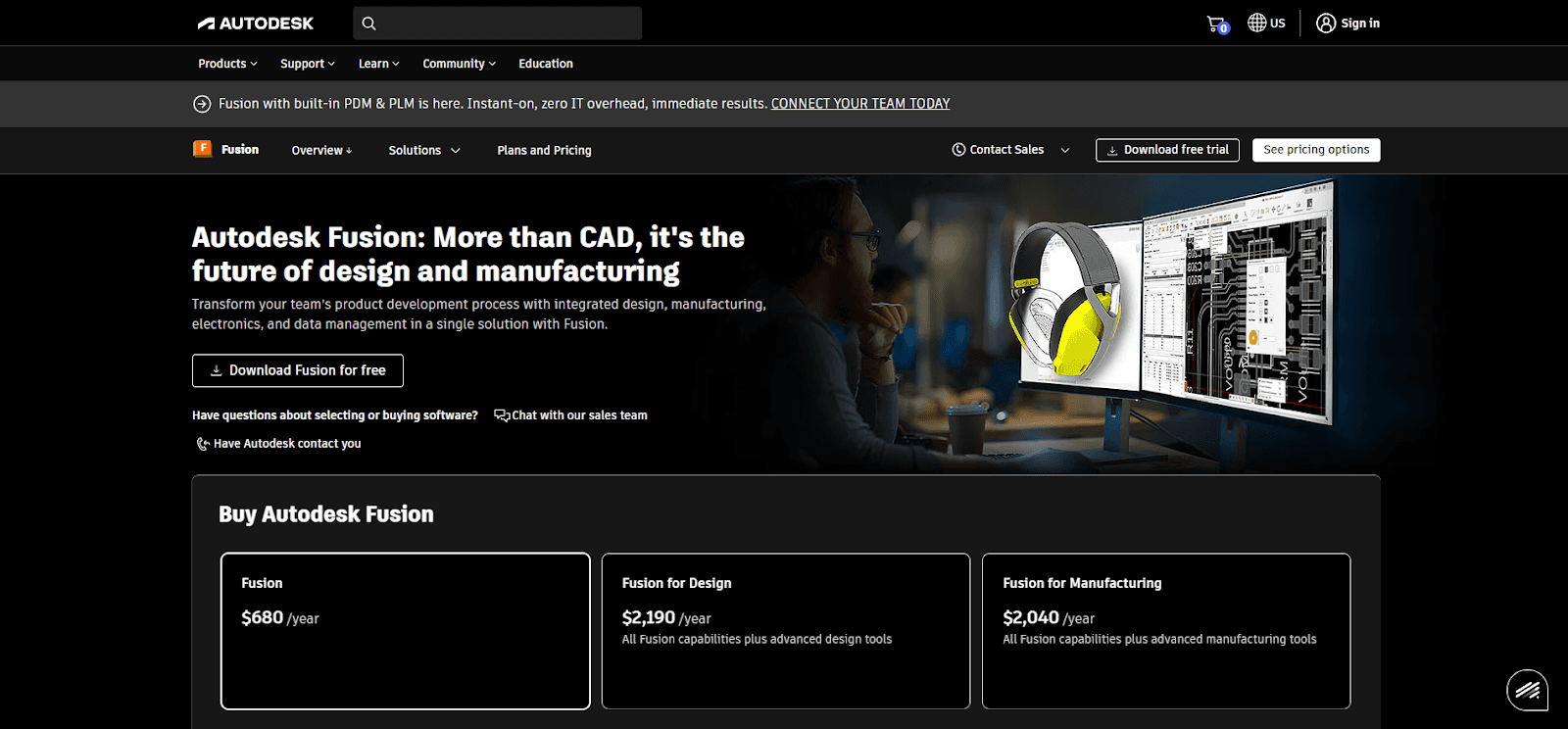
Autodesk Fusion is a cloud-based platform that unifies CAD, CAM, CAE, PCB design, data management, and collaboration for product development. It enables teams to work on the same models in real time from any location. The system supports design, simulation, engineering, manufacturing, and it includes built-in CAD assistants.
Why It's A Good Option For CAD Iteration
Autodesk Fusion helps teams iterate faster by storing all design data in one place. CAD files, simulations, and documentation stay synced automatically, reducing errors and preventing teams from working on outdated versions. Built-in version tracking makes it simple to review changes, compare iterations, and roll back if needed.
Fusion supports real-time collaboration for distributed teams. Commenting, markups, and shared views let stakeholders, including clients and manufacturers, provide feedback without a CAD license.
Cloud access ensures everyone sees the latest design instantly, keeping projects organized and decisions aligned. Integrated manufacturing workflows allow design updates to flow directly into assemblies and toolpaths, cutting down on errors and the delays of exporting between different software.
Additionally, AI-driven generative design explores thousands of optimized options quickly to give teams strong starting points for further refinement. And companies like ReChaco have shown measurable gains from this workflow, reporting a 54% reduction in rework and a 29% increase in productivity.
Choosing a cloud-based CAD iteration assistant involves far more than comparing feature lists. Mechanical engineers must…
Weigh data security and intellectual property protection (especially when design files move to the cloud).
Integrate with existing PLM systems, CAD tools, and established workflows to determine whether the assistant accelerates your process or creates bottlenecks.
Consider performance and reliability under heavy computational loads as they can make or break your design cycles, while determining if the true cost extends beyond subscription fees to include training time, IT resources, and measurable ROI.
Think about the time you’ll have to invest. Every new tool carries a learning curve that affects team productivity during the transition period.
In this guide, we’ll examine the five best cloud-based CAD iteration assistants available today. We'll show you where to find these tools, what technical considerations matter most for mechanical engineering workflows, and how each platform handles common daily challenges.
TLDR
Picking a cloud-based CAD iteration assistant isn't just about features—you need to weigh data security, PLM integration, learning curves, and actual ROI. The four standouts right now:
Leo AI: Domain-specific AI trained on 1M+ engineering sources. Turns text prompts into full CAD concepts. Claims +30% time savings.
Autodesk Fusion: Unlimited generative design solutions, auto-constraints, and automated drawings. Real-time collab with solid version control.
Onshape: Fully browser-based, real-time multi-user editing, built-in PDM. No file check-in/check-out headaches.
PTC Creo+: Full Creo power plus cloud collaboration. Great for teams already in the PTC ecosystem who want branching and auto-sync.
Bottom line:
Startups and distributed teams should prioritize real-time collaboration and low overhead (Onshape). Enterprise teams with established PLM systems will care more about integration and security (Creo+). High end start up and enterprise teams with an overwhelmingly established PLM will find it important to stay ahead with simple part search and management (Leo AI). That said, everyone benefits from faster iterations, fewer errors, and less time wasted on manual tasks.
IN PRACTICE
Leo AI
"The connection to our PDM and using that as a data source is legit the best thing ever. I found three viable bracket options fitting my exact envelope constraints — in minutes, not days."
— Eytan S., R&D Engineer
Where To Find Cloud-Based CAD Iteration Assistants
Engineering teams can find cloud-based CAD iteration assistants inside cloud-native CAD and PLM platforms that integrate AI through generative design features. Cloud-native CAD tools run directly in the browser, support real-time collaboration, provide automatic version control, and speed up each design cycle.
The assistant capability comes from AI-driven generative design, where engineers set goals, parameters, and constraints and the system produces a wide range of optimized design options. The workflow accelerates early-stage design exploration and helps teams iterate faster.
What To Consider When Choosing A Cloud-Based CAD Iteration Assistant
Mechanical engineers should consider:
Support for parametric and history-based modeling to maintain design intent and enable controlled modifications.
Integration options with PLM systems to improve workflows.
Features tailored to mechanical workflows, including sheet metal tools, frame generators, and code-based engineering calculations.
Capacity to manage large and complex assemblies while maintaining constraints and ensuring proper fit and function.
Compatibility with common industry file formats such as STEP and IGES to prevent data loss during collaboration.
Improved efficiency through reduced IT overhead, access to generative design, and advanced simulation capability.
High-quality 3D visualization for reviewing models from any angle and understanding real-world behavior.
Streamlined workflows supported by robust toolsets that simplify complex mechanical design tasks.
Summary Comparison: Best Cloud-Based CAD Iteration Assistants
Platform | Key AI/Generative Features | Benefit For Rapid Iteration |
Domain-Specific AI (Large Mechanical Model) pulling from 1M+ engineering sources + your PLM data. Conceptual design generation (images, documents, 3D models, product data sheets). Automated calculations (stress, materials, physics, etc.) with citations. Engineering Copilot for real-time, source-backed technical answers. | Accelerates early exploration & concept generation. Reduces design mistakes via validated insights. Automates repetitive engineering tasks. Quickly generates and tests design concepts. | |
Generative Design with unlimited cloud solves. Sketch AutoConstrain (AI auto-detects sketch constraints). Automated Drawings generated from 3D models. | Explores many optimized design variations instantly. Automates documentation and repetitive tasks. Uses virtual simulations to cut prototyping time. | |
Real-time multi-user collaboration (no file conflicts). AI Advisor for in-context design guidance. Built-in simulation for quick validate-iterate cycles. | Removes file management bottlenecks. Enables multiple designers to iterate simultaneously. Speeds up reviews and design changes. | |
Fully integrated Generative Design inside CAD/PLM. Behavioral Modeling Extension (BMX) auto-optimizes design parameters. | Produces manufacturable, optimized design options fast. Reduces time wasted on switching between tools. Streamlines entire design, analysis, and manufacturing workflow. |
FAQ
Stop Wasting Hours on Manual CAD Search
Leo AI turns your existing vault into a searchable knowledge base.
Leo AI connects to your PDM and makes every part findable by description in under 10 seconds. <a href="/onboarding">Try Leo Today</a>
Schedule a Demo →

#1 New AI Software Globally - G2 2026

Enterprise-grade security

Trusted by world-class engineering teams